Sunday, 6 July 2014

Chateau de Chenonceau


Chateau de Chenonceau was built in 1514-1522 on the site of an old mill on the banks of the river Cher. 25 years later, a covered bridge was added that spanned the river and allowed easy access to both banks. It passed through many hands including a number of influential women (hence its familiar name of Ladies Castle) including Catherine de' Medici in the 1560s who lived there until her death and built a number of gardens. Bought in 1913 by Gaston Menier of a family famous for chocolates, it has been in that family ever since. It was heavily damaged during the second world war and was restored in the 1950s to its current state.
Below is the entry to the Chateau.

A view of the Chateau crossing the river Cher
A view of the Chateau from across one of the formal gardenswith annuals planted in rows

Below is a walled garden with a raised promenade set into a wall on which lots of pots provide a very decorative relief.

Imagine watering all those pots!
The passage over the river from the Chateau.

Chateau Villandry

Located in the Loire Valley, Chateau Villandry was created in the 1500s by Jean Le Breton then minister of Finance. It was created in the French style rather than Italian and had magnificent gardens even then. It passed to a number of different families who made alterations to the gardens and the buildings and then fell into disrepair. In the early 1900s it was purchased by Dr. Joachim Carvallo and his wife Ann Coleman who was an American heiress. They restored the building and gardens back to their original French style. The Chateau has been in the family ever since and is currently owned by the great-grandson of Carvallo. Below is a view of the Chateau across the potager garden which is made up of decorative vegetables enclosed in hedges.

A view from the Chateau back towards the potager with the formal knot garden in the foreground
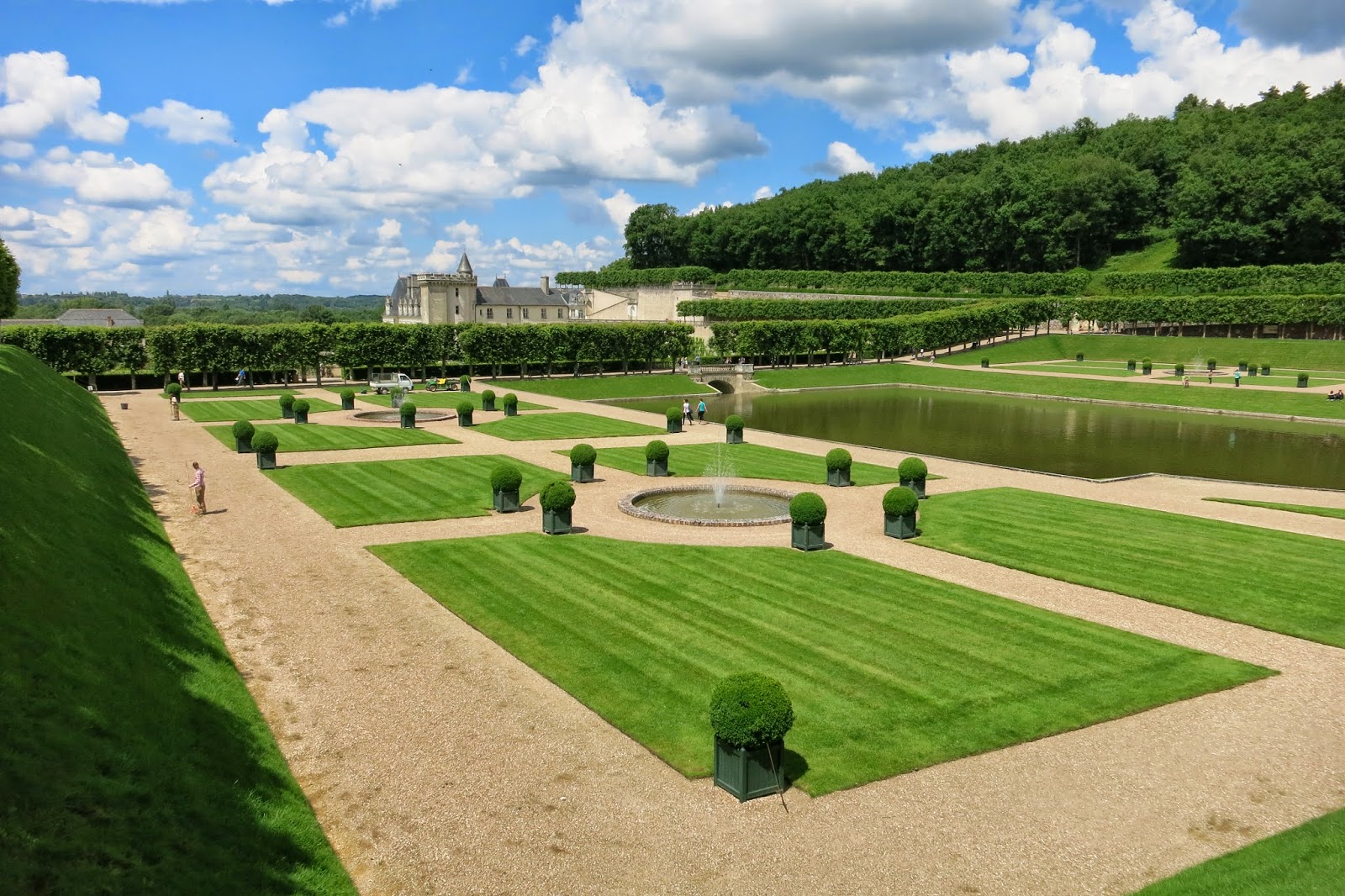
 To the side of the Chateau is a very formal yet simple garden of lawns, water and clipped bushes in containers


In another area to the right of this formal garden is a very English style garden with paths that radiate out from a fountain creating pie shaped beds which are filled with annuals and perennials with lots of colour and foliage texture.


A few of the beds have a colour scheme - in this case white.

Vaux Le Vicomte

South of Paris is the Vaux Le Vicomte which is a remarkable estate built over 350 years ago by the then finance minister of France, Nicolas Fouquet. Unfortunately for him, the King decided that this elaborate house and garden put Fouquet above even the King and therefore sent him to jail.
The main house with wings on either side looks out on a very formal garden and down a long vista. This is a view of the mansion from within the formal garden
The view of the gardens from within the mansion is spectacular
The view from the front doors shows the formal gardens in front and a  long vista to a statue of Apollo in the far (over 1 km) distance.
The formal gardens with their clipped small box hedges would have been filled with flowering annuals originally.
There are lots of water features and of course statuary
At the bottom of the long expanse of formal garden is a "hidden" water feature that is visible only when you walk towards it. The view extends over this feature and to the statue in the distance.


Wednesday, 2 July 2014

Gardens around Paris

In late May, we took the train from London to Paris through the tunnel. What a great way to go although the food on the train was terrible. The following picture shows that we really were in Paris on a cloudy rainy day:

GIVERNY:
Claude Monet first purchased this property in 1883 and developed a colorful garden around his house. The garden is in two parts, one near the house which has fruit trees, standard roses and densely packed flowers and the other across the road which consists of the water garden with the famous lily pond that he painted so often. Many years after Monet's death, the garden fell into disrepair and was not maintained. A group of American philanthropists took it over in the 1970s and restored it back to its original form. Fortunately there were good records, photographs, paintings and writings that documented what it looked like originally. This view is from the road toward the house on the left of the central axis.
This view is along the central axis. Originally when Monet bought the property, there was a row of cypresses along the central path which he found too dark and depressing. He had them taken down and replaced with rose trellises which you see today.

Here is a photograph of Monet himself in this part of the garden.

 To the right of the central axis are more flower beds densely planted with colour all season.
It is hard not to take a lot of pictures!
Some areas have grass at this time but are full of bulbs earlier in the spring
The view of the garden from inside the house is wonderful!
You go under the road these days through a tunnel to reach the water garden and its water lilies. 
 
All the different textures of green foliage make for a very appealing sight.

LA PROPRIETE CAILLEBOTTE:
Gustave Caillebotte lived in the second half of the 19th century and was both a supporter of the impressionist painters of the time but also an accomplished artist himself. His family moved to this country retreat on the Yerres River about 20 km south of Paris. Here they created a beautiful house and garden. The garden has sweeping lawns:
 There are more formal garden beds near the house and entrance to the garden
 Other parts near the river are less formal 
There was an extensive vegetable garden which is now maintained by a very enthusiastic group of volunteers.
 Note the glass covers which are put over tender plants each evening and removed during the day.
PARC DE BAGATELLE:
One of four botanic gardens of Paris, this Parc and its chateau were built in 1775 in just 64 days after a bet between Queen Marie-Antoinette and her brother-in-law Count Artois that it couldn't be done. It was! It is a large parc with walled areas, garden rooms and an expansive open area with roses. The walled garden had roses and clematis trained on the wall with garden beds alongside.
The mixture of different roses and clematis are very effective
A sunken iris garden surrounded by high hedges was still full of blooms
The feature of the whole gardens are the roses all of which are labelled and well maintained.


 Even the wildlife is spectacular


Monday, 30 June 2014

English Gardens

HAMPTON COURT:
The home of Henry VIII, the extensive palace hasn't been used except for special occasions for years. Located on the banks of the river Thames outside London, it has some excellent gardens including the "worlds oldest grapevine". Shown below is the enclosed rose garden which was in full flower during our visit.
The front of the palace has clipped yew trees, hundreds of years old, set in lawn with garden beds and large gravel paths which in this case lead from the palace to a fountain in the distance. It takes one man a whole day to clip one yew.
Around the corner from this view, is the side of the palace with a very formal clipped sunken garden.
 SCOTNEY CASTLE:
South east of London in Kent, Scotney Castle was a garden we hadn't seen before. It was magnificent with large rhododendrons and azaleas in full bloom. It is well worth a visit in the spring. It is set in the rolling Kent countryside on the banks of a river. The old castle, no longer in use, actually sits on an island in the river from which you can look up the through the gardens to the "new house".
Walking across the bridge to the old castle, you look along the moat which is densely planted.
Looking back up the hill toward the "new castle" you see the rhododendrons.
Again, a view across the moat.
GREAT DIXTER:
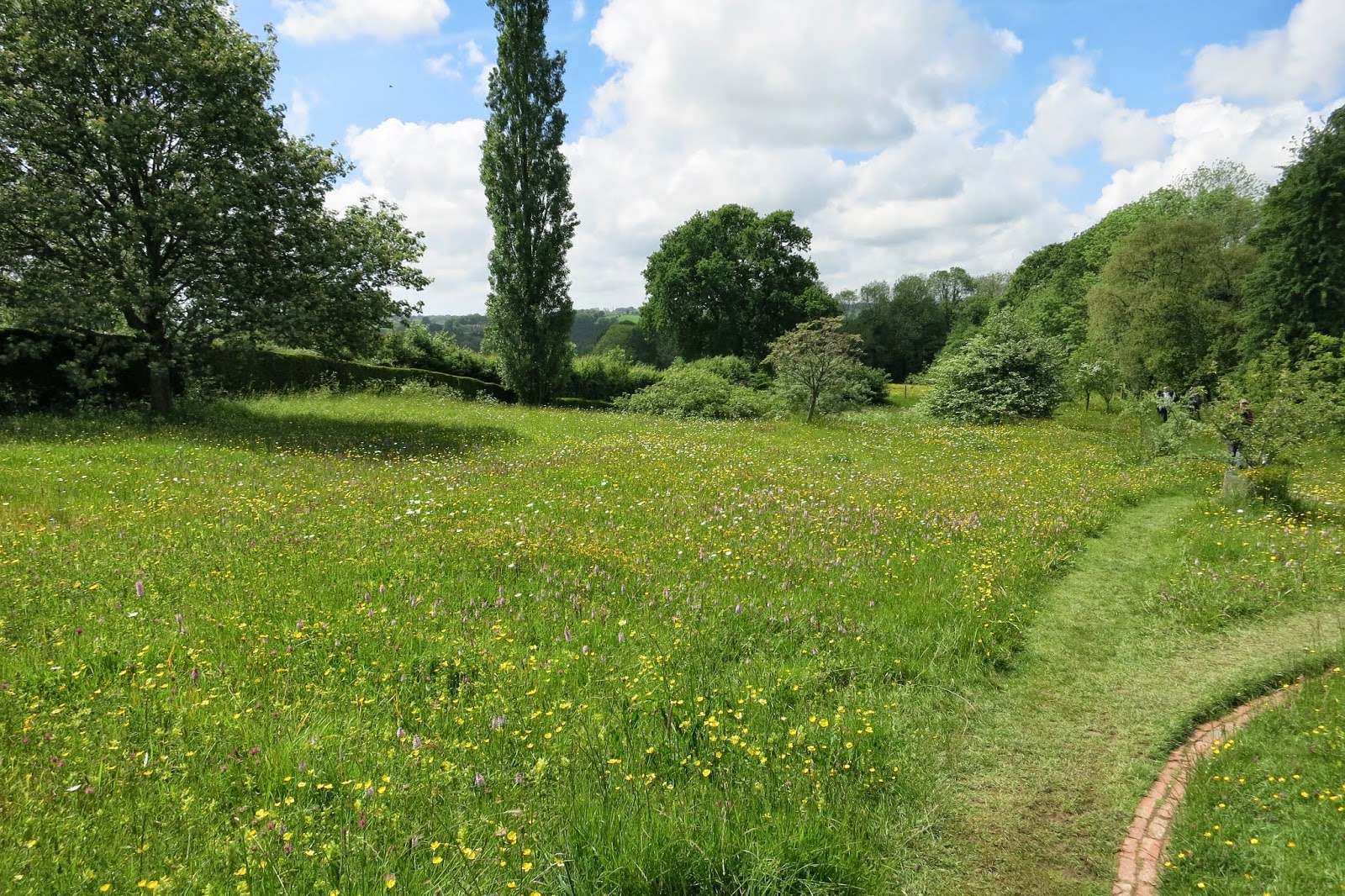
This garden is set around a 15th century house that was purchased by the Lloyd family about 1910 and rennovated with the help of the famous architect Edwin Lutyens. The house was finished about 1912 and the family moved in. Christopher Lloyd was born in the 1920s and he developed a passion for gardening. He expanded the existing garden as well as creating his own artistic style in the plantings. There are open meadows of wildflowers:

A more formal sunken garden

 Plants in pots massed together on the edge of a patio
 and garden beds crammed with massed plants many with bright flowers, but others with contrasting foliage.
There is an extraordinary mix of informal massed plantings and formal hedges and topiary


Christopher Lloyd really showed that you could create a garden that defies tradition yet still works wonderfully well. Below is a meadow of wildflowers, so informal, mixed with highly clipped and stylized bushes which are so formal, seen for example at Hampton Court. It all works brilliantly!

SISSINGHURST CASTLE:
Kent is also home to one of the most famous gardens in the UK, Sissinghurst Castle. Developed by Vita Sackville-West and her diplomat husband Harold Nicolson in the 1930's it surrounds an old castle and outbuildings. The gardens are designed in a series of rooms some as shown below with an expanse of grass with an English border.
Other garden rooms are "themed" with this garden being the famous "white garden" which unfortunately was not at its best for our visit, we were too early in the season.
Unfortunately the garden is so famous it is loved to death by large numbers of visitors which makes it hard to enjoy its beauty.

Some areas of the gardens have long stunning vistas, in this case with fragrant azaleas on the right and Chinese wisteria on the left.
Harold Nicolson's pet creation was the "lime walk" again providing a contrast with the more colourful and packed garden beds.